
Jamshid Mozafari
University of Innsbruck
Focuses on QA, information retrieval, and human-centered AI, including hint evaluation frameworks.
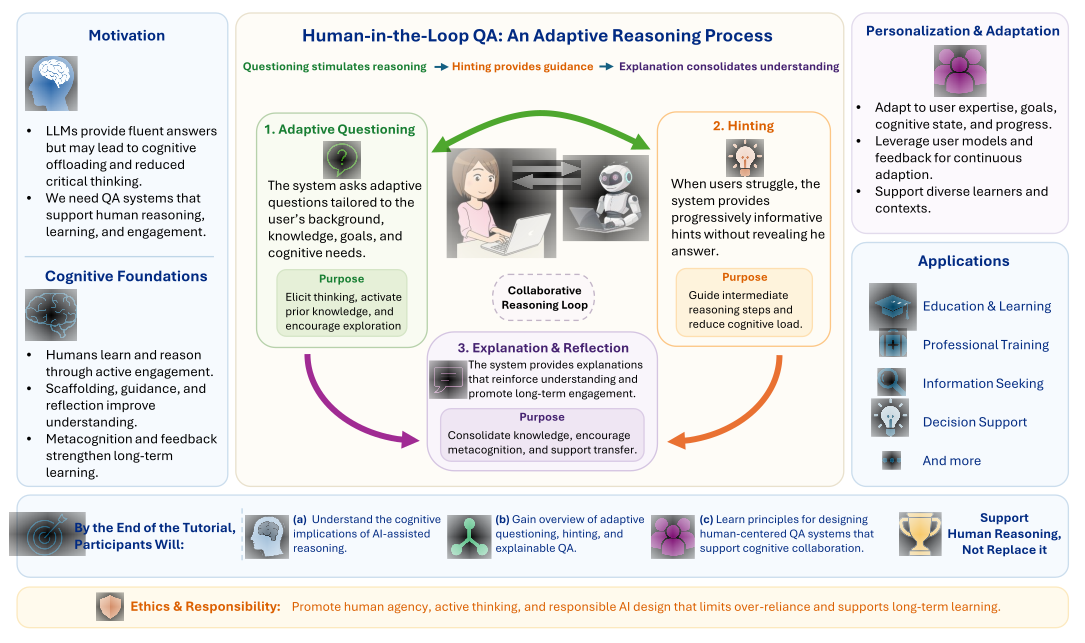
This tutorial presents HLQA as a collaborative QA paradigm that supports reasoning through adaptive questioning, hinting, and explanation.
Focuses on QA, information retrieval, and human-centered AI, including hint evaluation frameworks.

Works on personalized NLG, educational AI, and human-centered reasoning support.

Studies NLP for intelligent tutoring systems and adaptive educational technologies.

Researches responsible NLP, explainability, and computational methods for human-AI collaboration.

Specializes in information retrieval, text mining, and explainable QA with LLMs.
A stepwise path from foundational context to deployable human-centered QA systems.
From retrieval and extractive systems to LLM-based reasoning.
Cognitive load, scaffolding, metacognition, and learner engagement.
Socratic and learner-aware question generation strategies.
Progressive, non-revealing guidance for intermediate reasoning.
Explanations for understanding, reflection, and long-term learning.
User modeling and adaptive orchestration in applied settings.
Demonstrations across educational, research, and cognitive-support settings.
Evaluation gaps, ethics, and roadmap directions for HLQA.
QA evolution and the transition from answer-centric systems to collaborative cognitive support.
Cognitive load, scaffolding, and metacognitive principles for human-centered QA design.
Socratic prompting, decomposition, and personalized question generation with evaluation criteria.
Hinting techniques, quality metrics, and empirical evidence on educational effectiveness.
Pedagogical explanation patterns that improve understanding and support critical thinking.
User modeling and knowledge-tracing driven adaptation across learner profiles and goals.
Educational and research-assistance systems implementing HLQA principles in practice.
Roadmap for evaluation, ethics, multilingual settings, and robust collaborative QA benchmarks.
Yue, Z. (2025). Survey of LLM-based reasoning and modern QA systems.
Risko, E. F., & Gilbert, S. J. (2016). Cognitive offloading foundations and implications.
Jatowt, A. et al. (2023). Hint generation methods for reasoning-oriented QA interaction.
Fan, Y. et al. (2025); Schuff, H. et al. (2020). Explanation quality and pedagogical value.